


Does Spirulina Expire? Shelf Life and Storage Guide
, by The ENERGYbits® Team, 10 min reading time
, by The ENERGYbits® Team, 10 min reading time
Spirulina does expire, but slowly. Here is how long tablets and powder really last, how to store them properly, and the signs that a bag has lost its freshness.
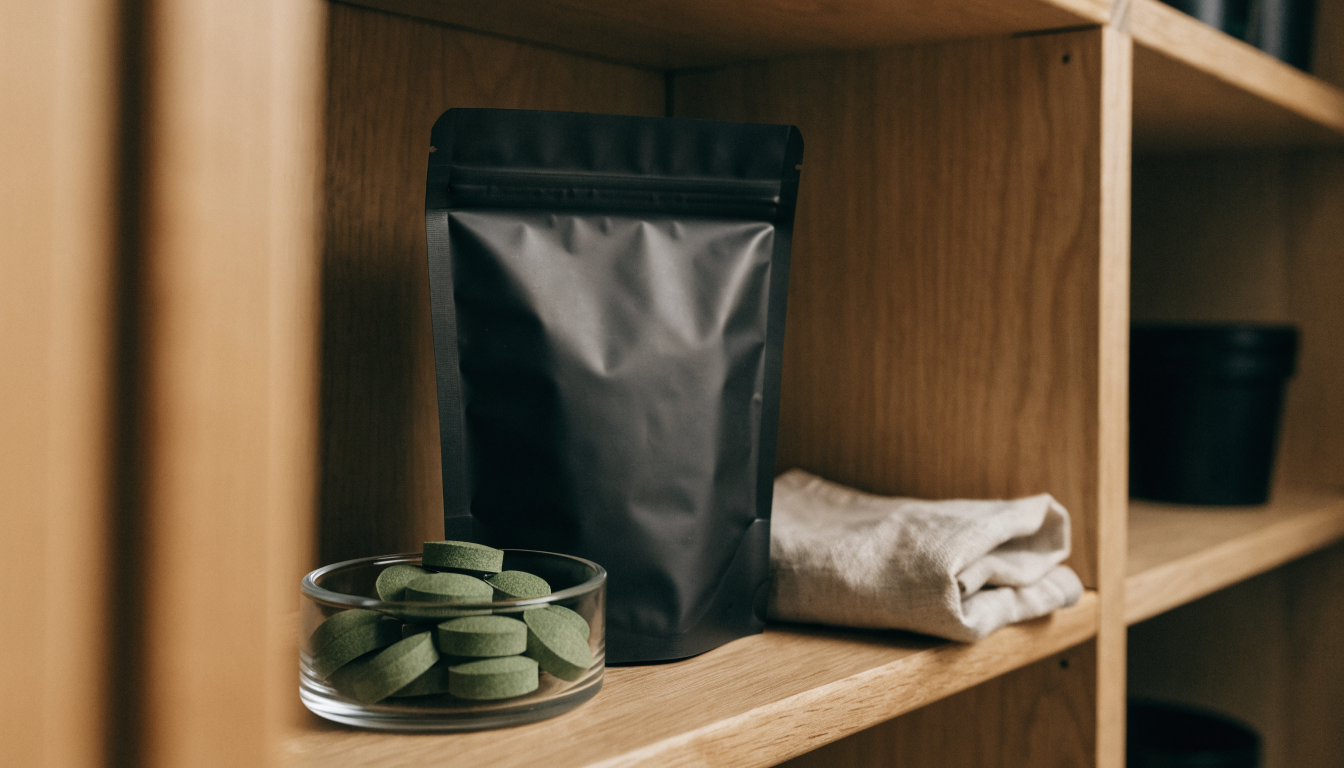
Cool, dark, dry, and sealed: four small habits that protect every tablet in the bag.
You bought a bag of spirulina with the best intentions, took it daily for a month, then it drifted to the back of a cupboard. Now you have found it again and the obvious question is whether it is still any good. The short version: yes, spirulina expires, but slowly, and how you store it matters more than the date printed on the pouch.
Spirulina is a dried whole food, not a chemical compound, so it does not spoil the way milk does. What it does is quietly lose potency. Over months and years, oxygen and light degrade the pigments (chlorophyll and phycocyanin), the carotenoids, and some of the more fragile B vitamins. Protein and minerals are far more stable and stay largely intact. That is why a good pouch carries a best-by date rather than a hard expiry: it marks the point where the maker can still guarantee full nutrient levels, not the moment the algae becomes unusable.
Unopened tablets in a sealed, light-blocking pouch generally hold up for two to three years from the manufacture date. Powder is a shorter story: roughly one to two years unopened, and about six to twelve months of best quality once you break the seal. If you are still choosing between formats, our spirulina tablets vs powder guide compares them on convenience, dosing, and freshness.
| Format | Unopened shelf life | After opening | Best storage |
|---|---|---|---|
| Tablets | About 2 to 3 years | 12 to 24 months of best quality | Resealed original pouch, cool dark cupboard |
| Powder | About 1 to 2 years | 6 to 12 months of best quality | Airtight opaque container, minimal headspace |
| Loose tablets in a pill case | Not applicable | Use within about 1 to 2 weeks | Opaque case, out of direct sun |
Surface area. Grinding algae into powder creates an enormous amount of exposed surface, and every speck of it meets oxygen and humidity the second the bag is open. A tablet is compressed, so only its outer skin touches the air while the inside stays protected. Powder also picks up moisture faster, which is what causes clumping and dulls both the color and the flavor. Tablets are simply a slower target for the things that wear algae down.
Light bleaches the pigments that give spirulina its deep blue-green color. Heat speeds up every degradation reaction, which is why a cupboard above the stove is the worst spot in the kitchen. Moisture invites clumping and, in bad cases, mold. Air brings oxygen, which slowly oxidizes the fatty acids and carotenoids. Control those four and shelf life takes care of itself.
Keep it in the original resealable pouch and press the air out before you close it. Choose a cool, dark, dry cupboard well away from the stove, kettle, dishwasher, and any sunny window. Resist the urge to decant it into a pretty clear jar on the counter, because that is light and heat exposure all day long. Skip the fridge and freezer too: every time you take a cold pouch into a warm room, condensation forms inside, and moisture is the one enemy you cannot undo. Room temperature and dry beats cold and damp every time.
ENERGYbits® Spirulina is grown, harvested, and low-temperature dried for nutrient integrity, then packed in a sealed, light-blocking pouch. One ingredient, third-party tested, zero fillers.
Shop ENERGYbits® Spirulina →Trust your senses. Fresh spirulina smells faintly green and oceanic, a little like dried seaweed. The warning signs are a musty, sour, or ammonia-like smell, a color that has faded from deep blue-green toward dull olive or brown, hard clumps in powder that were not there before, and a taste that reads sharp or rancid rather than mildly savory. If you are not sure what normal tastes like in the first place, our guide to what spirulina tastes like gives you a baseline to compare against.
In most cases it is simply weaker. Algae that is a few months past its best-by date but has been stored well is usually fine to finish, with slightly lower pigment and vitamin levels than a fresh bag. The real risk is not the date, it is poor storage: a pouch left open in a humid bathroom or a jar that got damp can grow mold, and that belongs in the bin, no debate. When in doubt, throw it out and start fresh. If you are new to algae and want to know what a normal adjustment period feels like versus a genuine problem, see our overview of spirulina side effects.
Tablets travel far better than powder, which is the whole argument for them on the road. Decant only a few days' worth into a small opaque pill tin or a zip pouch and leave the main bag at home in the cupboard. Keep it out of a hot car and out of the outside pocket of a bag that sits in the sun. On flights, tablets go through security without fuss. Knowing your daily serving makes portioning easy, and our spirulina dosage guide walks through how much to take per day so you can pack exactly what you need.
Join our newsletter for a simple day-by-day plan to build your algae habit, plus subscriber-only offers.
Send me the guide →If it was stored cool, dark, dry, and sealed, spirulina a few months past its best-by date is usually fine to finish, just slightly less potent. If it smells musty or sour, has faded badly, or shows any sign of moisture, discard it.
It is better not to. Moving a cold pouch into a warm kitchen creates condensation inside the bag, and moisture is what causes clumping and mold. A cool, dark, dry cupboard is the better home.
Faded color almost always means light or heat exposure, which breaks down chlorophyll and phycocyanin. The product may still be usable, but potency has dropped. Store the next bag in an opaque, sealed pouch away from sunlight.
Tablets in a resealed, light-blocking pouch hold their quality for roughly 12 to 24 months. Powder is more delicate, so aim to use it within six to twelve months of opening.


