


How Many Spirulina Tablets Equal a Teaspoon of Powder?
, by The ENERGYbits® Team, 9 min reading time
, by The ENERGYbits® Team, 9 min reading time
A level teaspoon of spirulina powder weighs about 3 to 4 grams, which works out to roughly 6 to 8 standard 500 mg tablets. Here is the full conversion table plus how to check your own dose.
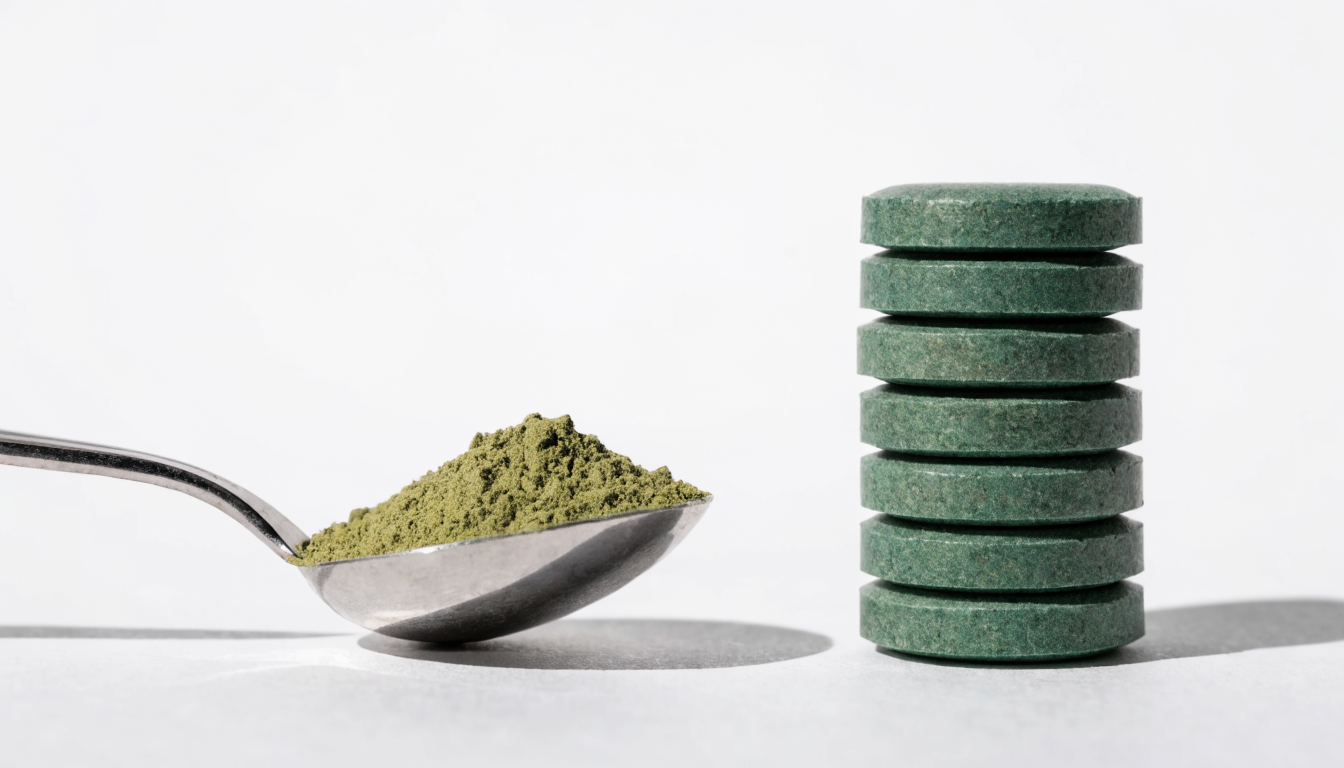
One level teaspoon of spirulina powder and its rough equivalent in 500 mg tablets.
This question usually comes from someone in the middle of a switch. Maybe you used powder for a year and got tired of the green film on everything in your kitchen. Maybe you read a study that reported grams and you are holding a bag of tablets. Either way, you want a number you can act on today.
The math is simple once you know two things: what a teaspoon of powder weighs, and how many milligrams are in each of your tablets. Below is the conversion, why the numbers come as a range, and how to check your own dose at home.
A level teaspoon of spirulina powder typically weighs 3 to 4 grams. Spirulina is light and finely milled, so it does not pack as densely as sugar or salt. A standard tablet is 250 mg, which is a quarter of a gram, so you divide the gram weight by .25. Three grams gives 12 tablets. Four grams gives 16 tablets.
So the working answer is 12 to 16 tablets per level teaspoon. Heap your spoon and you lean toward the higher end. Very fine, airy powder sits at the lower end. Either way you land in the right neighborhood, which for a daily food is what matters.
Here is the conversion laid out for the three measures people ask about most. All tablet counts assume a 250 mg tablet.
| Powder measure | Approximate grams | Approximate 250 mg tablets |
|---|---|---|
| 1/2 teaspoon | 1.5 to 2 g | 6 to 8 tablets |
| 1 teaspoon | 3 to 4 g | 12 to 16 tablets |
| 1 tablespoon | 9 to 12 g | 36 to 48 tablets |
A tablespoon is three teaspoons, so the tablet count simply triples. That is a lot of tablets, which is why tablespoon-sized servings are mostly the territory of athletes and long-time users who worked up gradually. Most daily users land between a half teaspoon and a full teaspoon of equivalent.
Three grams of spirulina is 12 tablets if each tablet is 250 mg. This is the figure people search for most, because 3 grams sits at the bottom of the commonly cited daily range of 3 to 5 grams that appears throughout the research literature and in our complete spirulina dosage guide.
Running the rest of that range: 4 grams is 16 tablets, and 5 grams is 20 tablets. If you are working from a teaspoon-based recipe or habit rather than a gram target, the practical translation of a 3 to 5 gram daily intake is roughly 12 to 20 tablets, and if your teaspoons run heaped you may be closer to 20 to 32 tablets to match what you were actually consuming as powder.
Volume measures are estimates of weight, not measurements of it. Three things move the number. Mill fineness comes first: a more finely ground powder holds more air and weighs less per spoonful. Packing is second: tapping the spoon compacts the powder and can add a full gram compared with a gently filled, leveled spoon. Moisture is third: powder left open in a humid kitchen clumps and weighs slightly more.
This is why every honest answer to this question is a range. If you want a real number rather than an estimate, a small digital kitchen scale that reads in grams is the most accurate method and costs very little. Weigh your usual spoonful once, note the number, and you never have to guess again.
For most people, yes. A tablet is pressed to a fixed weight, so 6 tablets is 3 grams every single time regardless of humidity, mill fineness, or how you hold the spoon. There is no scale required and no mental math at the counter. You can count them into your hand in five seconds and be done.
Tablets also remove the mess. Powder stains countertops, clings to blender lids, and has a distinctly oceanic flavor that some people never make peace with, which we cover in what spirulina actually tastes like. Swallowing tablets bypasses taste entirely. The broader trade-offs, including cost per gram, are in our comparison of spirulina tablets versus powder.
Check the supplement facts panel for milligrams per tablet, then divide your gram target by that number. If your tablets are 250 mg, a teaspoon equivalent is 12 to 16 tablets rather than 6 to 8. If they are 1000 mg, it is 3 to 4 tablets. Some brands also list a serving size in tablets alongside the total grams, which saves you the arithmetic.
Also check what else is in the tablet. Many pressed tablets include binders, fillers, or flow agents, which means the milligram figure is not all algae. A tablet that is 100 percent spirulina delivers the full stated weight as nutrition, so the conversion math above holds exactly.
ENERGYbits spirulina tablets are 100 percent algae with no binders or fillers, so 6 tablets really is 3 grams. Grown in fresh water, third-party tested, and easy to count into your hand on the way out the door.
Shop ENERGYbits spirulina →Aim for a consistent daily gram target and let the tablet count follow. Research on spirulina reports intake in grams per day, so grams connect your routine to the evidence. A tablet count is just the delivery mechanism, and it changes the moment you switch brands.
Practically, pick a number like 3 grams or 5 grams, convert it once for the tablets you actually own, and then stop thinking about it. Many people find it easier to split the count across the day, for example 5 tablets in the morning and 5 in the early afternoon, rather than taking the whole amount at once. Going higher is not automatically better either, and there are sensible upper limits worth knowing about, which we discuss in can you take too much spirulina.
If you are brand new to algae, start lower than your eventual target. One to two grams daily for the first week, building up over two to three weeks, gives your digestion time to adjust. Research suggests benefits accumulate with steady daily intake rather than any single large serving.
Practical dosing guidance, research summaries, and honest answers delivered to your inbox.
Join the newsletterAbout 12 to 16 tablets, assuming a standard 250 mg tablet and a level teaspoon of powder weighing 3 to 4 grams. Heaped spoons push you toward the higher end of that range.
Roughly 36 to 48 tablets. A tablespoon is three teaspoons, so it holds about 9 to 12 grams of powder, which triples the teaspoon tablet count.
Yes, if accuracy matters to you. A digital kitchen scale removes the variation caused by mill fineness, packing, and humidity. Weigh your usual spoonful once and you will know your real number.
Gram for gram they are equivalent when the tablet is pure algae with no binders or fillers. The difference is convenience, dosing precision, and taste rather than nutritional content.


