



Spirulina vs Multivitamin: Can Algae Replace Your Daily Vitamin?
, by The ENERGYbits® Team, 10 min reading time
, by The ENERGYbits® Team, 10 min reading time
Spirulina and a multivitamin do different jobs. This guide compares what is actually in each one, where algae genuinely shines, and where it honestly falls short.
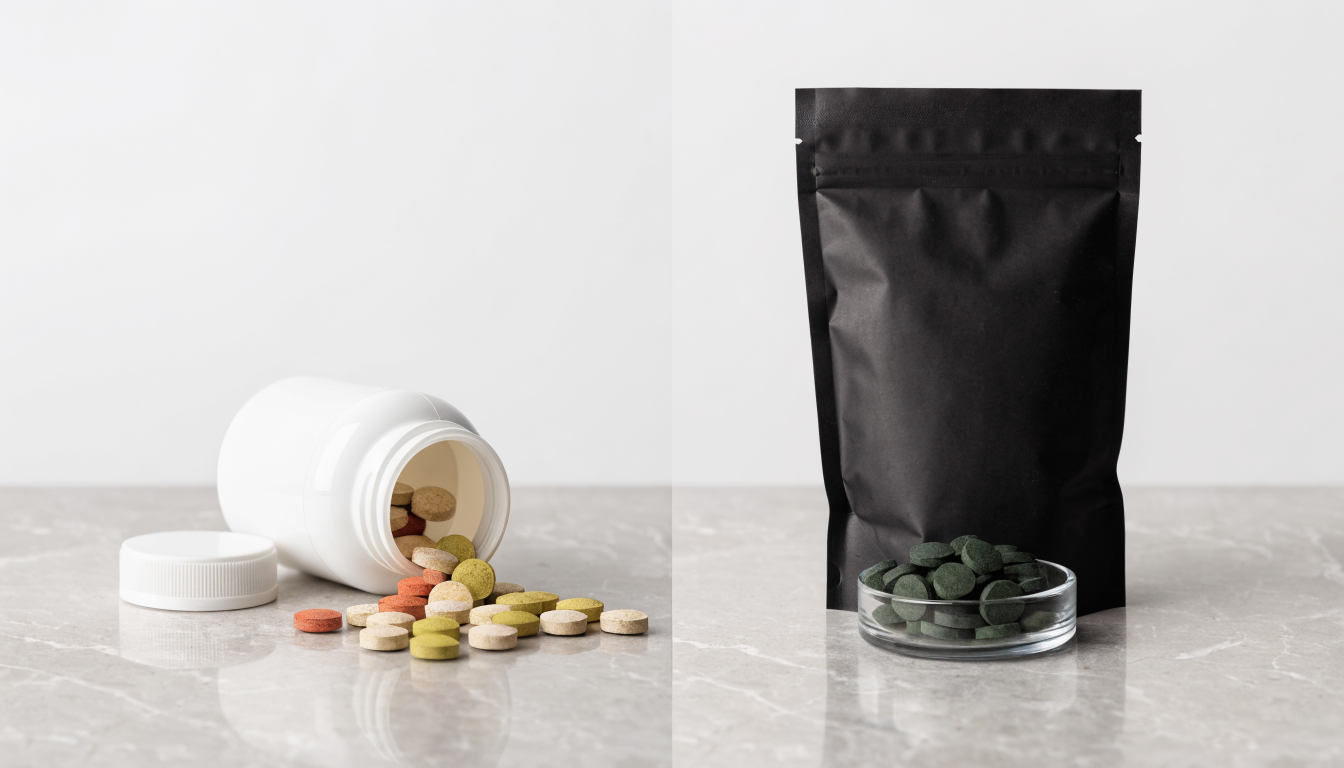
Two very different approaches to daily nutrition, side by side.
It is a fair question, and it gets asked a lot. If spirulina is famously nutrient dense, why keep swallowing a synthetic tablet every morning? The honest answer is that the two products are built on completely different philosophies, and understanding that difference is more useful than picking a winner.
A multivitamin is a formulation. Someone chose a list of vitamins and minerals, decided on a dose for each, sourced them as isolated compounds, and pressed them into a tablet or capsule. Many of those nutrients are synthesized in a lab, others are extracted from natural sources and purified. The doses are often set at or above 100 percent of the daily value, which is why a single tablet can list twenty or more nutrients at high numbers. That precision is the whole point of a multivitamin, and it is genuinely useful if you are filling a known gap.
What a multivitamin does not contain is food. There is no protein, no fiber, no chlorophyll, no plant pigments, and none of the thousands of minor compounds that come along for the ride when you eat something whole.
Spirulina is the opposite. Nobody formulated it. It is a blue green algae that is harvested, dried, and pressed into tablets with nothing added. Everything in it grew there, which means the nutrients arrive in the ratios and forms the organism produced them in.
By dry weight, spirulina is roughly 60 percent protein, and that protein contains all nine essential amino acids, as our guide on whether spirulina is a complete protein explains in detail. It also supplies naturally occurring iron, several B vitamins, beta carotene, chlorophyll, and phycocyanin, the blue pigment that gives spirulina its distinctive color and much of its antioxidant reputation.
This is the heart of the comparison. Research suggests that nutrients delivered inside a food matrix often behave differently from the same nutrients delivered in isolation, because cofactors, enzymes and accompanying compounds can influence how they are absorbed and used. Food bound iron, for example, tends to be gentler on digestion than a high dose isolated iron salt, which is a common complaint with some multivitamins.
The trade off is dose. A whole food gives you what it naturally contains, not what a label designer wanted it to contain. So spirulina delivers moderate amounts of many nutrients in a form your body recognizes, while a multivitamin delivers large amounts of specific nutrients in a form that is easy to quantify. Neither approach is universally better.
In several places, and they are not small. Protein is the obvious one, since a multivitamin contains none at all and spirulina is one of the most protein dense foods on the planet gram for gram, as our breakdown of how much protein is in spirulina lays out.
Then there is phycocyanin, which no multivitamin contains, along with chlorophyll, beta carotene and the broader antioxidant profile that comes with a pigmented whole food. Spirulina also carries naturally occurring B vitamins and a form of iron that many people find easier to tolerate than an isolated supplement. If you are comparing spirulina to other green supplements rather than to a vitamin, our comparison of spirulina and greens powders covers that ground.
Here is the part most algae articles skip. Spirulina is not a reliable source of active vitamin B12. It contains a compound that looks like B12 on older lab tests but is largely pseudo B12, which the human body cannot use the same way. Anyone eating a vegan or vegetarian diet should not rely on spirulina for B12 and should use a proven source instead. Our detailed look at whether spirulina contains B12 explains the science behind that.
Spirulina is also low in vitamin C, contains no meaningful vitamin D, and supplies far less calcium than a formulated multivitamin. If you take a multi specifically for bone support, immune support through vitamin C, or a diagnosed vitamin D deficiency, spirulina will not cover those bases.
| Nutrient or factor | Typical multivitamin | Spirulina |
|---|---|---|
| Protein | None | Roughly 60 percent by dry weight, complete profile |
| Iron | Isolated salt, often high dose | Naturally occurring, food bound |
| B vitamins | Synthetic, often above 100 percent DV | Naturally occurring, moderate amounts |
| Active B12 | Reliable and measured | Not reliable, largely pseudo B12 |
| Vitamin C | Usually a full daily value | Very little |
| Vitamin D | Usually included | None meaningful |
| Calcium | Often included | Small amount only |
| Phycocyanin and antioxidants | Not present | Naturally present |
| Chlorophyll | Not present | Naturally present |
| Overall form | Isolated nutrients, formulated | Whole food, nothing added |
ENERGYbits is pure spirulina pressed into tablets, with no fillers, binders or synthetics. A whole food foundation for your daily routine.
Shop ENERGYbits SpirulinaMost people who make the change do not treat it as a one for one swap. They use spirulina as a whole food foundation, something real and unprocessed that shows up every single day, and then keep or adjust targeted supplements based on what their bloodwork and their provider actually say they need. That is a more honest framing than declaring algae a vitamin replacement.
If you are taking a multivitamin for a specific diagnosed deficiency, talk to your healthcare provider before changing anything. That is not a disclaimer for the sake of it. Iron, vitamin D and B12 levels are worth measuring rather than guessing at.
Consistency matters more than quantity. Most people take tablets with water, start with a smaller serving, and build up over a couple of weeks. Tablets are popular because there is no taste to manage and the serving is easy to count, which makes a daily habit much easier to keep. Like any whole food, spirulina works best alongside a varied diet rather than in place of one.
Join our newsletter for plain-language guides on spirulina, chlorella, and everyday wellness.
SubscribeNot as a direct one for one swap. Spirulina is a whole food rich in protein, iron, B vitamins and antioxidants, but it is low in vitamin C, vitamin D and calcium, and it is not a reliable source of active B12. Many people use it as a foundation rather than a replacement.
No. Spirulina contains mostly pseudo B12, a form the human body cannot use the same way as active B12. Vegans and vegetarians should use a proven B12 source and speak with their healthcare provider about testing their levels.
Research suggests nutrients in a food matrix can behave differently from isolated versions, because cofactors and accompanying compounds may influence absorption and use. The trade off is that whole foods deliver moderate natural amounts rather than precisely formulated doses.
Many people do, since they cover different ground. Spirulina adds whole food protein, pigments and antioxidants while a multivitamin targets specific nutrients. If you take medication or manage a health condition, check with your healthcare provider first.


