


What Is Beta Carotene in Spirulina? Benefits Explained
, by The ENERGYbits® Team, 10 min reading time
, by The ENERGYbits® Team, 10 min reading time
Beta carotene is the orange provitamin A pigment tucked beneath spirulina's blue green color. Here is how much spirulina contains, how your body converts it, and what it may support.

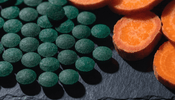
Spirulina looks blue green, but the same orange pigment family that colors carrots and sweet potatoes is packed inside.
Spirulina gets called a green food, which is a little misleading. The green comes from chlorophyll, the blue from phycocyanin, and underneath both sits a layer of orange and yellow carotenoid pigments you cannot see.
Beta carotene is the best known of that group. It is also the one most people are already familiar with from carrots, so it is a useful bridge for understanding what a few grams of dried algae actually gives you.
Beta carotene is a fat soluble orange pigment in the carotenoid family. Plants, algae and some bacteria make it to capture light energy and to shield their own cells from the oxidative stress that photosynthesis generates.
When you eat it, beta carotene does two things. It behaves as an antioxidant in its own right, and it serves as raw material your body can turn into vitamin A. That second role is why it is classed as a provitamin A carotenoid rather than a vitamin.
Preformed vitamin A, or retinol, comes mostly from animal foods like liver and egg yolk. Beta carotene is the plant and algae route to the same destination.
Most conversion happens in the cells lining your small intestine, where an enzyme called beta carotene oxygenase 1 cleaves the molecule down the middle and the halves are processed into retinol.
The important part is that this enzyme is regulated by feedback. When your vitamin A stores are already comfortable, your body dials conversion down. That built in brake is why plant provitamin A is not associated with the toxicity risk of high dose preformed retinol.
Conversion is also not one to one. Standards generally assume roughly 12 micrograms of dietary beta carotene yields about 1 microgram of retinol activity equivalent, and research suggests genetics can shift a person's efficiency in either direction.
This is where honest numbers matter more than a headline. Published analyses commonly report dried spirulina at roughly 150 to 200 mg of beta carotene per 100 grams, against about 8 mg per 100 grams for raw carrot. By weight that is a gap of around twentyfold, which is a large part of why spirulina keeps showing up in conversations about the most nutrient dense food on the planet.
The catch is portion size. Nobody eats 100 grams of spirulina. A realistic daily serving is a few grams, while a cup of chopped carrot is well over 100 grams. Once you compare real servings, the two land in the same neighborhood.
| Food | Approx. beta carotene per 100 g | Realistic serving | Beta carotene per serving |
|---|---|---|---|
| Spirulina, dried | 150 to 200 mg | 3 g | 4.5 to 6 mg |
| Carrot, raw | 8.3 mg | 1 cup chopped (128 g) | 10.6 mg |
| Sweet potato, baked | 9.4 mg | 1 medium (150 g) | 14 mg |
| Kale, raw | 5.9 mg | 1 cup chopped (67 g) | 4 mg |
| Spinach, raw | 5.6 mg | 2 cups (60 g) | 3.4 mg |
Values are approximate and vary with strain, growing conditions and drying method, so read them as a sense of scale rather than a lab certificate.
Beta carotene is the largest share of spirulina's carotenoid fraction but not the only one. Spirulina also supplies zeaxanthin, which is unusual, since few foods beyond corn, egg yolk and leafy greens contribute much of it. Smaller amounts of cryptoxanthin, echinenone and myxoxanthophyll fill out the profile.
Zeaxanthin is a xanthophyll rather than a provitamin A carotenoid, so your body does not convert it to retinol. It concentrates in the macula of the retina alongside lutein, where it has been studied for filtering blue light.
All of these orange and yellow pigments are visually overwhelmed by chlorophyll and by the blue pigment phycocyanin that gives spirulina its blue green cast. Color tells you almost nothing about what is inside.
Carotenoids are fat soluble, which means they need dietary fat and bile to form the mixed micelles that carry them across the intestinal wall. Take them with a glass of water on an empty stomach and you will absorb some, but studies consistently show better uptake when fat is present.
You do not need much. Research on carotenoid rich meals suggests even 3 to 5 grams of fat improves absorption, and that avocado or olive oil on a salad raises uptake several times over. In practice, taking your ENERGYbits spirulina tablets alongside breakfast, nuts or any meal containing fat is the simple move.
Vitamin A is required for normal vision, for epithelial tissue including skin and the lining of your airways and gut, and for the function of several immune cell types. Adequate vitamin A status is relevant to all three, though no single food is responsible for any outcome.
For vision, the retina needs retinal, a vitamin A derivative, to make the light sensitive pigment rhodopsin, and spirulina's zeaxanthin adds a second angle. If that is your main interest, we go deeper on whether spirulina is good for your eyes.
For skin, vitamin A plays a role in epidermal cell turnover, and carotenoids accumulate in skin tissue where they have been studied as part of the body's antioxidant defense. There is more in our piece on how spirulina may support skin. None of this is a treatment claim.
ENERGYbits spirulina tablets are a single ingredient food: organically grown spirulina, no binders or fillers, nothing else added.
Shop ENERGYbits spirulina →Short, plain English explainers on the pigments, nutrients and research behind algae nutrition. No hype, no spam.
Join the list →Not as preformed retinol. Spirulina supplies beta carotene, a provitamin A carotenoid that your body converts into vitamin A on demand. The practical result is vitamin A activity, delivered through a self regulating step.
Not at normal servings, because conversion to vitamin A slows when your stores are full. Very high carotenoid intakes over long periods can turn the palms and soles faintly orange, a harmless and reversible change called carotenodermia.
They are not the same thing. Spirulina delivers beta carotene inside a whole food matrix alongside zeaxanthin, phycocyanin, chlorophyll, protein and minerals. Isolated high dose beta carotene supplements have raised safety questions in smokers in past trials.
Roughly 3 grams of dried spirulina lands in the same range as one medium raw carrot for beta carotene. Spirulina is far more concentrated per gram, but the serving is much smaller, so the per serving totals end up comparable.
Carotenoids are reasonably heat stable but sensitive to light, oxygen and prolonged high temperatures. Tablets stored sealed and away from sunlight hold their pigment content well, which is why spirulina is dried gently rather than cooked.


