


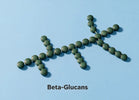
Beta-Glucans in Algae: What the Immune Research Shows
, by The ENERGYbits Team, 29 min reading time
, by The ENERGYbits Team, 29 min reading time
Beta glucan algae explained: Euglena paramylon trials, chlorella immune research, why spirulina differs, and how oat and yeast beta-glucans compare today.
Search for "beta glucan" and you will find oats, baker's yeast, mushrooms and, increasingly, algae. They are not interchangeable. Beta-glucan is a family of molecules, and the version in your oatmeal behaves differently from the one in a microalga called Euglena. The most direct human evidence for an algal beta-glucan comes from two randomized trials of Euglena gracilis, both reporting fewer cold-like symptom days than placebo. Chlorella has its own human immune trial, though it never claimed beta-glucan as the reason. Spirulina earns its reputation elsewhere. This guide sorts out which algae offer what, with the sample sizes, funding and limits of each study in plain view.
ENERGYbits® • Immune Nutrition
Quick Answer
Which algae contain beta-glucan? Euglena gracilis is the standout: it stores a linear beta-1,3-glucan called paramylon, reported at 70 to 80 percent of its carbohydrate content [4]. In two randomized trials, Euglena products were associated with fewer cold-like symptom days than placebo [1][2]. Spirulina is not described as a beta-glucan source in the algal reviews we read, and the glucan reported in chlorella is a different, cyclic type [4].
Beta-glucans are polymers of glucose joined by beta linkages, mainly 1,3 and 1,4 bonds, and sometimes 1,6 branches. They occur in cereals, fungi, yeast, bacteria and some microalgae [4]. In the gut, they are classed as dietary fiber: the laboratory method used to measure total dietary fiber (AOAC 991.43) is the one the Euglena researchers used to quantify beta-glucan content in their product [1].
The immune interest comes from how some beta-glucans are recognized. Reviews describe receptors on immune cells, including Dectin-1, complement receptor 3 and Toll-like receptors, that bind beta-1,3-glucans and set off signaling and cytokine release [10][11]. That is the proposed mechanism. A mechanism is a reason to run trials, not proof that a supplement does anything in people, so the rest of this article is organized around what the human trials found.
If you want the broader picture of immune nutrition first, our posts on Does Chlorella Support Your Immune System?, Does Spirulina Boost Your Immune System? and Immune Support Nutrients With Evidence cover whole-food angles. This piece zooms in on one compound and one question: which algae actually bring it.
"Beta-glucan" on a label tells you the chemical family, not the structure, source, dose or study. Structure matters because immune receptors respond to shape, and research on one source does not transfer to another.
| Source | Structure | Typical human research focus | What to know |
|---|---|---|---|
| Oats and barley | Beta-1,3 and 1,4-linked [4] | Blood cholesterol | EFSA concluded a cause-and-effect link between oat beta-glucan and lower blood LDL cholesterol at 3 g or more per day [7]. This is a cardiovascular finding, not an immune one. |
| Baker's yeast | Beta-1,3 with 1,6 branches [5][11] | Upper respiratory symptoms, mucosal immune markers | Small randomized trials report fewer symptom days or lower symptom scores; doses in the hundreds of milligrams [5][6]. |
| Euglena gracilis (paramylon) | Linear beta-1,3-glucan, 70 to 80% of carbohydrate in the cell [4] | Cold-like symptoms | Two randomized trials, 2019 and 2025, both industry-funded [1][2]. |
| Chlorella | The glucan reported in C. pyrenoidosa is a cyclic beta-1,2 type at under 5% [4] | Whole-chlorella immune markers | A human trial of whole chlorella raised NK cell activity and cytokines, without attributing it to beta-glucan [3]. |
| Spirulina | Not listed among algal beta-glucan producers in the reviews we read [4] | Other components, such as phycocyanin | Immune research centers on pigments and other compounds; see our spirulina immune guide. |
Euglena gracilis is a single-celled, freshwater microalga. It stores energy as paramylon, granules of linear beta-1,3-glucan, and a review of microalgal beta-glucans lists Euglena at 70 to 80 percent of its carbohydrate content, far above the other microalgae in the same table [4]. That is why almost all of the algal beta-glucan research you will find uses it.
Evans and colleagues, working with the ingredient maker Kemin, ran a 90-day randomized, double-blind, placebo-controlled trial in London, Ontario [1]. Thirty-four endurance-trained adults aged 21 to 65 took either one 367 mg capsule a day of a Euglena gracilis fermentate (more than 50 percent beta-1,3-glucan) or a placebo. The outcome was self-reported upper respiratory tract infection (URTI) symptoms on the WURSS-24 questionnaire.
How to read this trial
The study was small (27 people in the efficacy analysis), funded by the product sponsor with some Kemin employees as authors, ended recruitment early, and did not meet its primary outcome. Several of the favorable findings came from secondary and post-hoc analyses. Immune biomarkers were not measured; the results rest on symptom reports [1]. Treat it as encouraging and preliminary.
A larger randomized, double-blind trial published in 2025 by Nakashima and colleagues gave 213 healthy Japanese adults (aged 21 to 82) either 1,000 mg of Euglena gracilis powder or a starch placebo in a capsule once daily for 8 weeks [2]. Participants kept symptom diaries.
How to read this trial
This is the more robust of the two designs: a defined primary outcome that was met and a bigger sample. Limits remain. Euglena Co. Ltd. funded the study and employed two authors, symptoms were self-reported in diaries, and the authors note that they did not measure immune cell activity, so the beta-glucan mechanism is a hypothesis [2]. The test material was whole Euglena powder, which also contains protein and other nutrients, so the effect cannot be attributed to paramylon alone.
Quick Answer
Do Euglena beta-glucan trials show it supports immunity? Two randomized, placebo-controlled trials in healthy adults reported fewer days with cold-like symptoms on Euglena: a 34-person trial of a fermentate in 2019 and a 213-person trial of whole powder in 2025 [1][2]. Both were industry-funded and symptom-based, so the evidence is encouraging but still early.
One practical note for readers of an algae company's blog: ENERGYbits sells spirulina and chlorella, not Euglena, and these trials used different organisms and different products. We include them because they are the best human evidence on algal beta-glucan, and because an honest answer to the topic requires them.
Chlorella has a human immune trial of its own, and it is worth stating what that evidence is and is not.
In an 8-week randomized, double-blind, placebo-controlled trial in Korea, Kwak and colleagues gave healthy adults 5 g a day of Chlorella vulgaris tablets (23 participants analyzed) or placebo (28 analyzed) [3]. After 8 weeks the chlorella group showed a significant rise in serum interferon-gamma and interleukin-1 beta, a trend toward higher interleukin-12, and increased natural killer (NK) cell activity, with larger increases than placebo [3]. The authors suggest a beneficial immunostimulatory effect of short-term chlorella supplementation in healthy people.
How to read this trial
This was a small study and partly funded by the chlorella manufacturer that supplied the tablets. It measured immune markers, not infections or symptoms, so it does not show that people got sick less often [3]. The 5 g dose is below the 7.5 g ENERGYbits full serving (30 tablets of 250 mg, a calculation from the label), and it was a different product, so it is not a dose recommendation.
Here is where an honest article has to disagree with some of the internet. Online, chlorella is often described as a beta-1,3-glucan source. The Kwak trial does not mention glucan as the active component [3]. A 2025 review of microalgal beta-glucans lists the glucan reported in Chlorella pyrenoidosa as a cyclic beta-1,2 type, present at under 5 percent, and discusses it in a bacterial-symbiosis context rather than an immune one [4]. That is a different molecule from the linear beta-1,3 paramylon in Euglena.
That does not make chlorella irrelevant to immune research. Laboratory work on polysaccharides isolated from chlorella is active: a 2025 study of a purified Chlorella pyrenoidosa polysaccharide (CPP-3a) reported that it activated macrophages in cell culture through TLR4 and TLR2 signaling [9]. That is a cell-culture result, an interesting lead and not a human outcome. So the fair summary is this: whole chlorella has a human trial with positive immune markers; chlorella polysaccharides are being studied in the lab; and no human trial we found shows that chlorella works through beta-1,3-glucan.
What chlorella does bring to the table is nutritional: chlorophyll, protein and micronutrients in a whole food, and in ENERGYbits chlorella, a cracked cell wall for digestibility. For more on that angle, see our guide to Does Chlorella Support Your Immune System?.
Spirulina is a cyanobacterium, not a eukaryotic alga, and the reviews of algal beta-glucan that we read name Euglena and several other microalgae but not spirulina [4]. The nutrition data point the same way: USDA FoodData Central lists dried spirulina at about 3.6 g of dietary fiber per 100 g [8]. By calculation, an ENERGYbits full serving of 7.5 g (30 x 250 mg tablets) supplies roughly 0.27 g of total fiber, and beta-glucan, if any, could only be a fraction of that.
This is not a knock on spirulina. It is a reason to ask what spirulina is for. Its nutritional case rests on protein, phycocyanin, chlorophyll, vitamins and minerals, and its immune research focuses on other components such as phycocyanin and polysaccharide fractions studied in the laboratory. If you came here asking whether spirulina is a beta-glucan supplement, the answer is no. If you are asking whether it belongs in an immune-minded diet, our dedicated guide, Does Spirulina Boost Your Immune System?, walks through that evidence on its own terms.
Quick Answer
Is spirulina a good source of beta-glucan? No. Spirulina is a cyanobacterium and is not named as a beta-glucan source in algal beta-glucan reviews [4]. Dried spirulina has about 3.6 g of fiber per 100 g, so a 7.5 g serving supplies about 0.27 g of total fiber (calculation) [8]. It is valued for protein, phycocyanin, chlorophyll, vitamins and minerals instead.
The strongest regulatory-grade finding for any beta-glucan is for oats and barley, and it concerns cholesterol rather than immunity. EFSA's panel concluded in 2010 that a cause-and-effect relationship exists between oat beta-glucan intake and lower blood LDL cholesterol, with a daily intake of at least 3 g of beta-glucan for the claim [7]. Cereal beta-glucan is soluble, viscous fiber; it is a different tool from the particulate, immune-oriented beta-glucans in yeast and Euglena.
Yeast beta-1,3/1,6-glucan has a growing set of small randomized trials on upper respiratory outcomes. A 2026 trial in Japan randomized 40 healthy adults to a yeast glucan or placebo for 12 weeks; the yeast group reported fewer days with upper respiratory symptoms, and mucosal immune markers such as secretory IgA were better preserved [5]. The authors call these preliminary observations. A 12-week trial of 198 moderately stressed adults reported lower respiratory symptom scores at 120 mg and 204 mg a day than placebo, with only the 204 mg dose exceeding the minimal clinically important difference [6]. Yeast evidence is more developed than algal evidence, though its own authors still call it early.
Headlines love the verb "boosts." A few habits help you read past it.
What the research says
Algal beta-glucan has a plausible mechanism and a small number of encouraging human trials, all in Euglena. For chlorella and spirulina, the supportable statements are about whole-food evidence and nutrition, not about beta-glucan [1][2][3][4].
Whatever you decide about supplements, the evidence for the basics is stronger than for any single compound. Our Immune Support Nutrients With Evidence article walks through vitamin D, zinc, vitamin C and food sources in detail. In brief:
Beta-glucans are studied precisely because they interact with the immune system, so a short precautions note belongs here. Spirulina and chlorella are generally well tolerated. Check with your healthcare provider before taking them if you are pregnant or nursing, have phenylketonuria, have an autoimmune condition, take immunosuppressant medication or blood thinners, have a bleeding disorder, or have thyroid or iodine concerns (relevant to chlorella). People managing autoimmune conditions or taking immunosuppressants in particular should talk to their clinician before adding any product marketed for immune support, algal or otherwise. ENERGYbits products are third-party tested for purity and contaminants.
Many people ease into a new whole-food supplement gradually. That is common practice, not a clinical recommendation. ENERGYbits tablets are 250 mg each, and a full serving is 30 tablets (7.5 g). Both spirulina and chlorella are single-ingredient whole foods with no fillers or additives, freshwater-grown, gently dried at low temperatures and third-party tested for purity and contaminants.
If you are curious about spirulina for its protein, phycocyanin and chlorophyll, start with the ENERGYbits spirulina. If you would like both algae together, the VITALITYbits spirulina and chlorella blend combines them. Neither is a beta-glucan product and neither is sold to treat or prevent any condition. They are whole-food nutrition.
Evidence-first nutrition, weekly
Get one evidence-first nutrition article a week: what the research shows, what it does not, and how whole foods fit in. No hype, just sources.
Join the newsletterKey takeaways
Beta-glucan is a legitimate and interesting area of immune nutrition, and algae have a real place in it, specifically Euglena gracilis, which has two randomized trials behind its paramylon story. The honest edges are equally clear: small, industry-funded, symptom-based studies that call for independent replication.
For the algae ENERGYbits grows, the picture is different but still positive. Chlorella has a human trial with encouraging immune markers, and spirulina brings protein, phycocyanin, chlorophyll and minerals. Neither needs to be a beta-glucan source to earn a place in a whole-food routine.
Beta-glucan is a family of glucose polymers with beta linkages, found in oats, barley, yeast, mushrooms, bacteria and some microalgae. Structure varies by source, which affects how the body responds [4]. Cereal beta-glucan is soluble fiber studied for cholesterol; yeast and Euglena beta-glucans are studied for immune outcomes.
Euglena gracilis is the best-documented, with a linear beta-1,3-glucan (paramylon) at 70 to 80 percent of its carbohydrate content [4]. Other microalgae contain smaller amounts of various types. Spirulina is not named as a beta-glucan source in the reviews we read, and the glucan reported in Chlorella pyrenoidosa is a cyclic beta-1,2 type at under 5 percent [4].
Spirulina is a cyanobacterium and is not described as a notable beta-glucan source in algal reviews [4]. Dried spirulina has about 3.6 g of total fiber per 100 g, so a 7.5 g serving provides about 0.27 g (calculation) [8]. It is valued for protein, phycocyanin, chlorophyll, vitamins and minerals instead.
Evidence for the linear beta-1,3 type is lacking. One 2025 review lists the glucan reported in Chlorella pyrenoidosa as a cyclic beta-1,2 type at under 5 percent [4]. Chlorella contains other polysaccharides studied in the laboratory [9]. A human trial of whole chlorella reported higher NK cell activity without attributing it to beta-glucan [3].
Paramylon is the storage carbohydrate of Euglena gracilis, a linear beta-1,3-glucan that makes up most of the cell's carbohydrate content [4]. Randomized trials of Euglena products, whose beta-glucan is paramylon, reported fewer days of cold-like symptoms than placebo, though the authors note the mechanism was not directly measured [1][2].
Two randomized, placebo-controlled trials reported fewer days with cold-like symptoms on Euglena products: 213 adults taking 1,000 mg of powder for 8 weeks [2], and 34 active adults taking a 367 mg fermentate for 90 days, where the primary outcome was not met but secondary measures favored Euglena [1]. Both were industry-funded and relied on self-reports.
No. The 8-week trial of 5 g a day of chlorella measured immune markers, finding higher NK cell activity, interferon-gamma and interleukin-1 beta than placebo [3]. It did not measure infections or symptoms, and it was a small study partly funded by the manufacturer.
It is better studied. Small to moderate randomized trials of yeast beta-1,3/1,6-glucan report fewer upper respiratory symptoms or better mucosal immune markers [5][6], while algal beta-glucan evidence is mostly two Euglena trials. The molecules differ, so results do not transfer between them, and the authors of each describe their findings as early.
Its best-supported benefit is cholesterol. EFSA concluded that oat beta-glucan at 3 g or more per day lowers blood LDL cholesterol [7]. Oat beta-glucan is a soluble fiber and is not the same as the particulate beta-glucans studied for immune outcomes.
Very little by itself. It does not tell you the source, structure, amount or whether the dose matches a trial. Look for the organism, the milligrams of beta-glucan and the studies on that exact product, and keep in mind that results from one source do not carry over to another.
People who are pregnant or nursing, who have phenylketonuria, an autoimmune condition, a bleeding disorder, or thyroid or iodine concerns, or who take immunosuppressants or blood thinners should consult their healthcare provider first. This applies to immune-support products in general.
A full serving is 30 tablets, each 250 mg, for 7.5 g in total. The chlorella immune trial used 5 g a day of a different product, which is not a dose recommendation [3].
This article is for educational purposes only and is not medical advice. These statements have not been evaluated by the FDA. ENERGYbits® products are whole-food supplements and are not intended to diagnose, treat, cure, or prevent any disease. Talk with your doctor before starting any supplement, especially if you are pregnant, nursing, taking medication, or managing a medical condition.


