


Spirulina vs Ashwagandha: Which Is Better for Energy and Stress?
, by The ENERGYbits® Team, 10 min reading time
, by The ENERGYbits® Team, 10 min reading time
Spirulina is a whole food that supplies the iron, B vitamins, protein and phycocyanin your cells use to make energy. Ashwagandha is an adaptogenic herb studied for the stress response, so the two answer different questions.

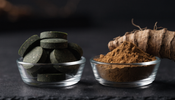
Green algae tablets on the left, standardized root powder on the right. Two very different tools.
Spirulina and ashwagandha are both marketed for energy. Both are marketed for stress. The label language sounds nearly identical.
The biology underneath is not identical at all. Spirulina is food. Ashwagandha is a botanical concentrated for an active compound. That single distinction explains almost every practical difference between them, from how much you take to how long you wait before anything changes.
Spirulina is a blue green algae that people have eaten as food for centuries. Dried, it runs roughly 60 to 70 percent complete protein by weight and carries iron, B vitamins, vitamin K, magnesium and the blue pigment phycocyanin. It is not an isolated extract, it is a dense whole food in tablet form.
Ashwagandha, or Withania somnifera, is a root with a long history in Ayurvedic practice. Nearly every product you see is a standardized extract, concentrated for a family of compounds called withanolides. A typical capsule delivers 300 to 600 mg of extract standardized to around 5 percent withanolides. At that dose the root contributes almost no measurable nutrition, and it is not designed to.
That is the fork in the road. One supplies material. The other supplies a signal.
Spirulina does not stimulate. It feeds. Fatigue often traces back to something missing, and low iron is among the most common gaps, particularly in women. Spirulina delivers iron alongside the protein and B vitamins your mitochondria use to convert food into energy. More on that in our explainer on whether spirulina gives you energy.
Because none of it is a stimulant, the experience is unlike coffee. There is no spike and no crash. Spirulina also contains no caffeine whatsoever, which is why many people take it in the afternoon without worrying about their evening.
Ashwagandha can also leave people feeling more energetic, but by an indirect route. If broken sleep and a revved up stress response are what drain you, settling that pattern may give energy back. That is friction removed rather than fuel added.
Here ashwagandha holds the more direct evidence. Several small randomized controlled trials, most 8 to 12 weeks long using 300 to 600 mg of standardized extract, have reported lower perceived stress scores and in some cases lower morning cortisol. Those trials are often industry funded, so read the effect sizes with caution, but the direction has been reasonably consistent.
Spirulina approaches the same territory nutritionally. Magnesium, B vitamins and steady protein all shape how well you tolerate a demanding week, and phycocyanin has been studied for antioxidant activity. Our piece on whether spirulina helps with stress walks through what that research does and does not support.
Sleep divides along the same line. Ashwagandha is usually taken in the evening, while algae tends to suit the first half of the day, a timing question we unpack in our guide to spirulina and sleep.
| Factor | Spirulina | Ashwagandha |
|---|---|---|
| What it is | Whole blue green algae, eaten as a food | Root extract standardized for active compounds |
| Primary mechanism | Supplies nutrients cells use to produce energy | Modulates the stress response and cortisol signaling |
| Nutrient content | 60 to 70 percent protein, iron, B vitamins, vitamin K, phycocyanin | Minimal at typical doses, roughly 5 percent withanolides |
| Best for | Feeling depleted, underfed, low on iron or protein | Feeling wired, tense, unable to wind down |
| Typical daily amount | 3 to 5 grams, about 10 to 16 tablets | 300 to 600 mg of standardized extract |
| Time to notice | Some notice within days, nutrient status shifts over 4 to 8 weeks | Most trials measure change at 4 to 12 weeks |
Choose spirulina if your sentence is: I am running on empty. Long days, skipped meals, a diet light on iron and protein, underfed rather than overstimulated. Many people respond to that feeling with a stronger coffee or a matcha, and our comparison of spirulina and matcha explains why the nutrient route behaves so differently. A standard serving is 10 to 16 tablets of ENERGYbits spirulina, roughly 3 to 5 grams.
Choose ashwagandha if your sentence is: I am wired and I cannot shut off. Racing mind at 11pm, tight shoulders, waking at 3am. That is a signaling pattern, not a nutrient gap, and an adaptogen is the more logical first attempt.
Ashwagandha is generally well tolerated, but it is a herb with real pharmacology, so its caution list runs longer. It is not recommended during pregnancy or nursing. It may influence thyroid hormone levels, which matters if you have a thyroid condition or take thyroid medication. It may add to the effect of sedatives, and rare case reports of liver injury exist.
Spirulina has a shorter list, though not an empty one. Choose a brand that tests for microcystins and heavy metals, since quality varies with growing conditions. People with phenylketonuria should avoid it, and anyone on blood thinners should discuss its vitamin K content with a provider.
Yes, and many people do, precisely because the two do not overlap. A common pattern is spirulina in the morning for the nutrient load and ashwagandha in the evening for the wind down. There is no known interaction between them.
If you are starting both, stagger them by a week or two. Add one, watch what changes, then add the other. Otherwise you will never know which one is responsible for what you feel.
ENERGYbits spirulina tablets are a single ingredient whole food: organically grown, third party tested, no caffeine and no fillers. One bag holds a month of daily servings.
Shop ENERGYbits Spirulina →Plain language science on energy, stress, sleep and nutrient density, sent to you weekly.
Join the newsletter →It depends on the cause. If you are nutritionally depleted, spirulina is the more logical match because it supplies iron, protein and B vitamins. If stress keeps you from sleeping well, ashwagandha has been studied more directly for that pattern.
Many people do, and there is no known interaction between them. A frequent routine is spirulina earlier in the day and ashwagandha in the evening. Introduce them a week or two apart so you can tell which one is doing what.
No. Spirulina is caffeine free and contains no stimulants. Any lift people describe comes from nutrients, which is why it does not produce a spike followed by a crash.
Most randomized trials use 300 to 600 mg per day of root extract standardized to roughly 5 percent withanolides for 8 to 12 weeks. Labels vary, so check the standardization and not only the milligram figure.
Anyone pregnant or nursing, with a thyroid condition or on thyroid medication, taking sedatives or immunosuppressants, or with liver concerns should speak with a healthcare provider first. Spirulina has fewer cautions but is not appropriate for people with phenylketonuria.


