


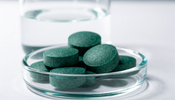
Does Chlorella Contain Heavy Metals? Purity and Testing Explained
, by The ENERGYbits® Team, 10 min reading time
, by The ENERGYbits® Team, 10 min reading time
Chlorella is known for binding heavy metals, which makes buyers wonder whether it accumulates them. The answer depends on where it is grown and whether every batch is independently tested.

Purity in chlorella is decided at the farm and confirmed in the lab, batch by batch.
Chlorella has a reputation as a binder. It has been studied for how it holds onto certain metals and compounds in the digestive tract, which makes a fair question come up often: if it grabs heavy metals, does the powder in the bag already carry them? The honest answer is that it depends almost entirely on the farm.
Two bags of chlorella can look identical, smell identical, and return very different purity results. The difference is rarely the species. It is the water the algae drank, the air above that water, how the harvest was handled, and whether anyone paid an independent laboratory to check before the product shipped.
The worry traces back to real research. The chlorella cell wall has been studied for how it interacts with certain metals, and a good share of that work sits in environmental science rather than nutrition, where algae are used to pull contaminants out of wastewater.
Reading that, it is reasonable to ask what ends up inside the algae. We cover the mechanism in our explainer on how chlorella binds heavy metals in the digestive tract. The short version is that binding inside your gut and accumulating during cultivation are two different events, separated by the entire growing and testing process.
It can, and no careful brand should dodge that. Microalgae take up what is dissolved in their water. If the source water carries lead, cadmium, mercury or inorganic arsenic, some fraction can end up in the harvested biomass. Open ponds also collect whatever settles out of the air above them.
So geography and infrastructure matter more than marketing language. A pond fed by a river that drains farmland and industry starts at a disadvantage no processing step fully undoes. A tank fed by filtered, tested freshwater in a monitored facility starts clean and stays measurable. Spirulina sits in the same conversation, which we unpack in our piece on whether spirulina contains heavy metals.
Here is how the common cultivation setups compare on the factors that actually drive purity.
| Growing setup | Contamination risk | Testing transparency | Typical cost |
|---|---|---|---|
| Open pond, unmonitored source water | Highest. Water and air inputs are both unknown | Often none, or one legacy certificate | Lowest |
| Open pond, filtered source water, no batch testing | Moderate. Water is cleaner, air is still open | Partial. Annual or occasional spot checks | Low |
| Controlled pond, filtered water, batch testing | Low. Inputs controlled and verified per lot | High. A certificate for every batch | Moderate |
| Closed photobioreactor, sealed loop | Lowest. Very little enters from outside | High when published, but not always shared | Highest |
| Any setup with no named lab or lot number | Unknown, which is best read as high | None that you can audit | Varies |
Closed systems are not automatically the answer. A photobioreactor can produce very clean algae and still ship without a current certificate, while a well run controlled pond with batch by batch testing gives you a number you can actually read.
A certificate of analysis, usually shortened to COA, is a laboratory report tied to one production lot. It names the lab, the lot number, the date, the test method, and the measured result for each analyte next to the limit it was compared against.
For heavy metals you want four names: lead, cadmium, mercury and arsenic. Results are reported in parts per million or micrograms per gram, and careful suppliers benchmark against California Proposition 65 thresholds or their own internal specification, which is often tighter than the legal floor.
Two details separate a useful COA from a decorative one. The lot number on the report should match the lot printed on your bag, and the laboratory should be independent rather than the grower's own bench. A report with no lot number is a brochure.
No, and treating them as one thing is a common mistake. Heavy metal panels measure elemental contamination. Microbial panels look for total plate count, yeast, mold, E. coli and salmonella. Microcystin testing screens for cyanotoxins, which can appear when blue green algae grows alongside other organisms in open water.
A brand can pass one panel and never run the others, so ask which panels sit in the standard release specification. Processing matters here too, since the method behind broken cell wall chlorella changes how digestible the algae is, and a clean process should not introduce anything new.
Six questions will separate the careful growers from the repackagers. Where is the algae grown, and what is the source water? Is every batch tested for heavy metals, or only some? Which independent laboratory runs the panel? Can you see a current COA with a matching lot number? Are microbial and microcystin panels standard? And does the tablet contain any fillers, binders or flow agents?
That last one matters more than people expect. Every added excipient is another supply chain with its own purity story. If a tablet is nothing but pressed algae, there is simply less to verify. For a wider framework, we walk through seven things to check before you buy an algae supplement.
ENERGYbits chlorella is grown in controlled freshwater, third party tested for heavy metals batch by batch, and pressed with no fillers or binders. You can see that sourcing approach on the RECOVERYbits chlorella page, and if you are new to algae it is worth reading about common chlorella side effects before settling on a daily amount.
RECOVERYbits is pure chlorella, third party tested for heavy metals batch by batch, with no fillers, binders or additives in the tablet.
Shop RECOVERYbits chlorella →Join our newsletter for plain-spoken algae education, sourcing notes and testing explainers.
Get the newsletter →No. Levels depend on where and how the algae was grown. Chlorella raised in filtered, monitored freshwater and screened lot by lot by an independent laboratory typically tests low, while algae from uncontrolled open water is far less predictable.
Lead, cadmium, mercury and arsenic are the four to look for, usually reported in parts per million. Many careful suppliers hold themselves to limits tighter than the legal floor and compare results against California Proposition 65 thresholds.
Yes, and the response is informative either way. A brand that tests batch by batch can usually produce a current report with a lot number that matches your bag. Vague answers or years-old paperwork tell you something too.
Not necessarily. A sealed photobioreactor controls inputs well, but purity you cannot verify is not purity you can rely on. A controlled pond with filtered water and batch testing may give you better documentation at a lower price.


