


Is Spirulina a Plant, a Bacteria, or an Algae?
, by The ENERGYbits® Team, 10 min reading time
, by The ENERGYbits® Team, 10 min reading time
Spirulina is technically a cyanobacterium, a photosynthetic bacterium, not a true plant and not a true algae. Here is why it is still sold as blue-green algae, and how it differs from chlorella.
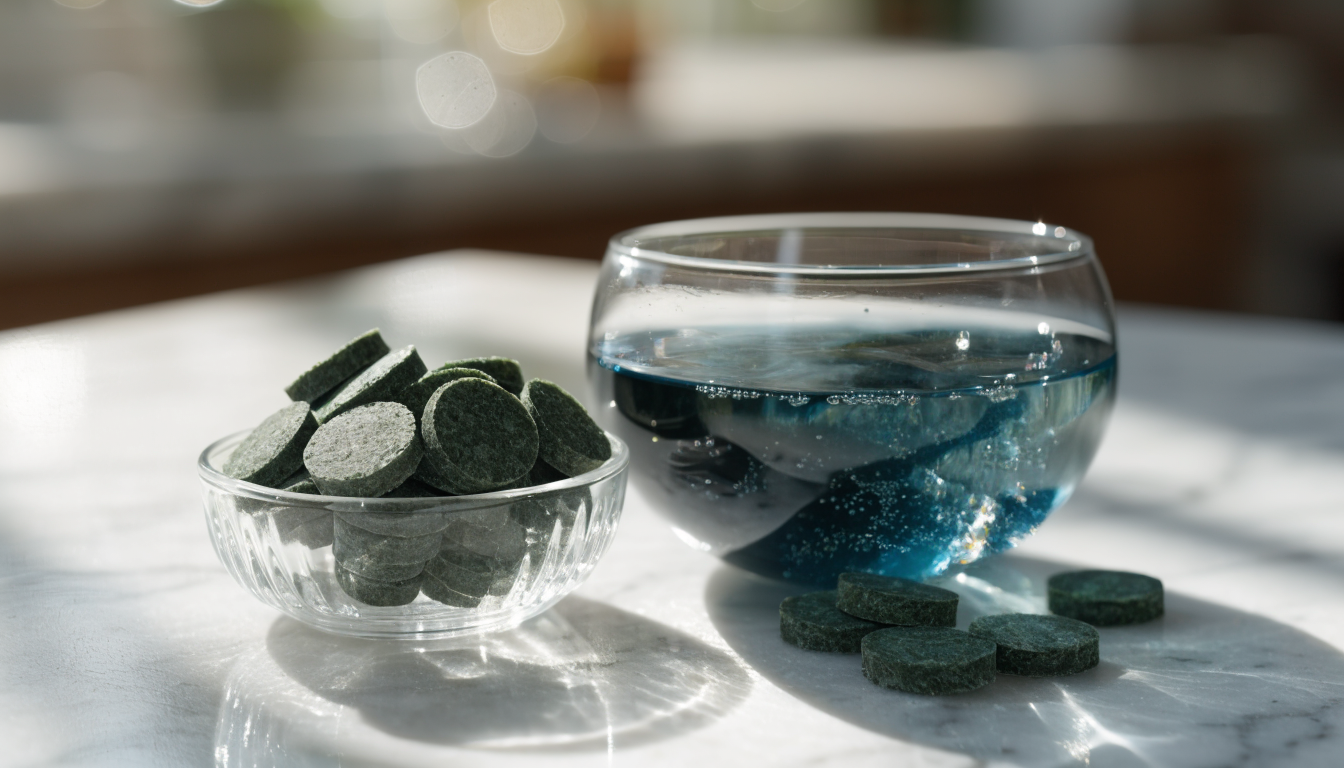
Spirulina tablets beside the deep blue-green water they come from.
Ask this question online and you get three confident answers, all of them different. Spirulina gets called a plant, an algae, and a bacteria, sometimes on the same page. The honest answer is the least marketable one, so here it is up front: spirulina is a cyanobacterium.
That single word does a lot of work. Cyanobacteria are ancient single-celled organisms that photosynthesize the way plants do, but their cells are built like bacterial cells. So spirulina behaves like a plant, is sold as an algae, and is classified as a bacterium. Only one of those three labels is taxonomically correct.
Cyanobacteria are prokaryotes, meaning their cells have no nucleus and no membrane-bound organelles. Their DNA sits loose inside the cell rather than packed into a nucleus the way yours is. They are among the oldest life forms we know of, credited with putting the first free oxygen into the atmosphere.
What makes them unusual among bacteria is that they photosynthesize. They carry chlorophyll, run on sunlight and carbon dioxide, and release oxygen. That is plant behavior housed inside a bacterial cell. Spirulina is one of these organisms, and in the wild it thrives in warm, alkaline lakes where little else competes. Commercial farms reproduce those conditions deliberately, as we cover in how spirulina is grown.
Because the naming came first and the microscopes came later. When nineteenth century scientists described these organisms, algae was a loose bucket for anything green that lived in water and made its own food. Spirulina fit, so it was filed under blue-green algae, a name describing its color rather than its cell structure.
Then electron microscopy showed these cells had no nucleus at all. Taxonomy was revised, the organisms were moved into the bacterial domain, and formally renamed cyanobacteria. By then blue-green algae was printed in textbooks, written into food regulations, and settled into ordinary speech. Regulators still list it that way and retailers still sell it that way. The old name won on momentum.
This is where the distinction stops being trivia. Chlorella is a true algae, a eukaryote with a proper nucleus, and it belongs to the green algae group, which sits far closer to land plants than spirulina does. The two get shelved side by side and treated as interchangeable, but biologically they are further apart than a mushroom and an oak tree. We put them head to head in spirulina vs chlorella.
The consequence you can notice is the cell wall. Chlorella wraps itself in tough cellulose that human digestion cannot break down, which is why reputable chlorella is mechanically cracked before it reaches you. Spirulina has no cellulose wall. Its outer layer is soft and built largely from sugars and proteins, so there is no cracking step and most people digest it comfortably. The pigments differ too. Alongside chlorophyll, spirulina carries phycocyanin, the blue compound behind that deep teal color, which we explain in what phycocyanin actually is.
| Feature | Spirulina | Chlorella | Leafy green plant |
|---|---|---|---|
| Classification | Cyanobacterium, sold as blue-green algae | True single-celled green algae | Plant, kingdom Plantae |
| Cell type | Prokaryote, no nucleus | Eukaryote, has a nucleus | Eukaryote, many cell types |
| Cell wall | Soft, no cellulose | Tough cellulose, usually cracked | Cellulose plus fiber |
| Pigments | Chlorophyll plus phycocyanin | Chlorophyll, very concentrated | Chlorophyll plus carotenoids |
| Digestibility | No processing needed | Needs cracking to be usable | Chewing and cooking help |
It is the reason plenty of people set the bag back down. Bacteria is a category, not a verdict. That category includes organisms that make you ill, and it also includes the lactobacillus cultures in your yogurt, the strains that turn milk into cheese, and the trillions already living in your gut doing useful work. Spirulina sits at the harmless end. It is not pathogenic, and communities around Lake Chad and Lake Texcoco ate it long before anyone had a word for what it was.
What genuinely deserves your attention is not the taxonomy but the water. Spirulina absorbs what surrounds it, so uncontrolled open ponds can pick up heavy metals or other cyanobacteria that have no business in food. Ask where a product was grown and whether each batch is tested. That question matters more than any classification debate.
Yes, in every practical sense. Spirulina is grown in water using sunlight, minerals, and carbon dioxide. Nothing animal goes in at any stage, and no animal is involved in harvesting or drying it. Most vegans and vegetarians include it without a second thought.
The technicality is that plant-based has become shorthand for not from an animal rather than a literal claim about the plant kingdom. By that everyday definition spirulina qualifies easily. By strict taxonomy it does not, because it was never in Plantae. We unpack the question in is spirulina vegan. What is worth watching is not the algae but what gets added to it.
ENERGYbits spirulina tablets contain a single ingredient, spirulina, with no binders, fillers, or capsule shells. They are simply pressed algae, so what the label says is what you swallow.
Shop ENERGYbits SpirulinaStart smaller than you think you need to. Many people begin with a few tablets taken with water in the morning and build up over a week or two rather than jumping straight to a full serving. Tablets can be swallowed whole or chewed, though chewing delivers a strong green, faintly oceanic flavor that not everyone enjoys on day one.
Timing is flexible. Because spirulina is a food rather than a stimulant, there is no clock to obey. Some take it before a walk, some with breakfast, some mid-afternoon. Consistency matters more than the hour. Keep the bag sealed and away from heat and light, since pigments like phycocyanin are sensitive to both. And if you are pregnant, nursing, or managing a health condition, talk with your healthcare provider first.
Join our newsletter for plain-language guides on spirulina, chlorella, and everyday wellness.
SubscribeSpirulina is a cyanobacterium, which means it is a photosynthetic bacterium. It is not a true plant and it is not a true algae, though it is grown, regulated, and sold everywhere as a blue-green algae. It makes its own food from sunlight and carbon dioxide, and it is classified as a food.
Spirulina is a food organism, not a pathogen, much like the live cultures in yogurt or the bacteria used to turn milk into cheese. People have eaten it for centuries. What matters far more than its classification is where it was grown and how carefully each batch was tested.
Chlorella is a true green algae with a tough cellulose cell wall that human digestion cannot break down, so quality chlorella is mechanically cracked during processing. Spirulina has a soft outer layer with no cellulose, so it needs no cracking and most people digest it easily as it is.
Yes. Spirulina is grown in water using sunlight, minerals, and carbon dioxide, with no animal input at any stage. Most vegans count it as plant-based even though it sits outside the plant kingdom. The thing to check is the finished product, since binders, flow agents, or gelatin capsules can change the answer.


