


How Is Spirulina Grown? From Farm to Tablet
, by The ENERGYbits® Team, 9 min reading time
, by The ENERGYbits® Team, 9 min reading time
Spirulina is farmed in shallow alkaline ponds, then filtered, washed, dried and pressed into tablets. Here is the full farm to tablet process, and what a buyer can actually verify.
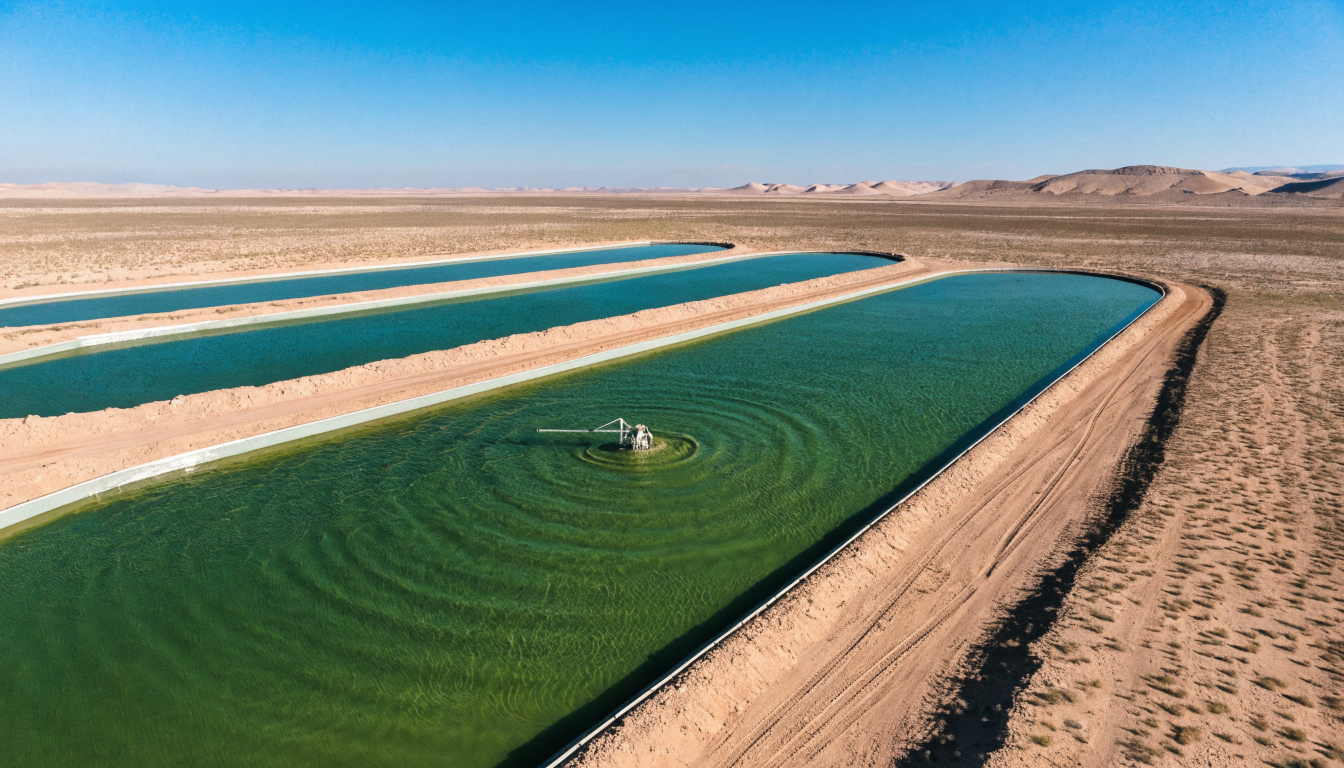
Most spirulina begins life in shallow ponds of alkaline fresh water, kept moving by a slow paddlewheel.
People ask us where spirulina comes from more than almost anything else, usually because a green tablet does not look like something grown on a farm. It is. Here is the journey in order, from pond water to the pouch on your counter.
Spirulina is a microscopic blue green algae that grows naturally in warm alkaline lakes, historically in parts of Africa and Central America, where people harvested and dried it long before anyone bottled it. Commercial spirulina is not scooped out of those lakes. It is cultivated on purpose built farms that recreate those conditions, which is the only way to keep it safe and consistent batch after batch.
Spirulina thrives in water most organisms cannot tolerate. Farms dose fresh water with mineral salts, mainly carbonates and bicarbonates, to hold the pond at a pH of about 9 to 11. Spirulina is at home there. Almost everything else, including competing algae, bacteria and grazing organisms, is not.
That high pH acts as a natural gatekeeper, which is why a well run pond needs no pesticides. The trade off is that the growing water becomes part of the product: whatever sits in the source water and mineral inputs can carry through to the harvest. That is why sourcing and testing matter, a point we cover in our article on whether spirulina contains heavy metals.
Most of the world's spirulina grows in open raceway ponds, long shallow loops of water perhaps 20 to 30 centimeters deep, stirred continuously by a paddlewheel. The paddlewheel does two jobs: it keeps the algae suspended rather than settling, and it cycles cells to the surface so each one gets its turn in the sunlight.
The alternative is a closed photobioreactor, a sealed system of tubes or panels where light, temperature, carbon dioxide and nutrients are managed precisely. Contamination risk drops sharply, as does exposure to dust, rain and birds. The catch is cost per kilogram produced.
| Factor | Open raceway ponds | Closed photobioreactors |
|---|---|---|
| Setup cost | Low to moderate, mostly earthworks, liners and paddlewheels | High, engineered tubes or panels plus pumps and controls |
| Contamination control | Relies on high pH plus monitoring, open to dust, rain and birds | Sealed from the outside, much tighter control |
| Environmental control | Limited, follows the weather and the season | Precise control of light, temperature and gas exchange |
| Typical yield | Lower per unit volume, but easy to scale across large areas | Higher per unit volume, harder and costlier to scale |
| Common use | The majority of food grade spirulina worldwide | Research, high value strains and specialty production |
Sunlight is the fuel and warmth is the throttle. Spirulina grows fastest in bright, steady light at water temperatures around 30 to 35 degrees Celsius, which is why commercial algae farming clusters near the tropics and in hot, sunny regions. A cloudy month slows growth. A cold snap can stall a pond entirely.
ENERGYbits Spirulina is a single ingredient tablet: organically grown spirulina, low temperature dried and compressed with no binders, fillers or additives.
Shop ENERGYbits SpirulinaWhen the culture reaches the right density, it is pumped across fine screens and filters that separate the algae from the growing water. What comes off is a thick, dark green biomass, closer to paste than powder. It is washed to remove residual mineral salts, then pressed to drive out moisture.
Drying is the single most important quality step in the chain. Heat degrades phycocyanin, the blue pigment behind much of spirulina's antioxidant reputation, along with chlorophyll, superoxide dismutase, and several heat sensitive vitamins. Fast, high temperature drying is cheap and efficient, and it costs the batch some of what made it valuable. Low temperature drying is slower and more expensive to run, and it preserves noticeably more. Our explainer on what phycocyanin is covers why that pigment matters.
From here the paths diverge. Dried spirulina can be milled into powder, filled into capsules, or compressed directly into tablets. A well made tablet is simply spirulina pressed under mechanical force until the particles bind to one another, with no binders, flow agents, fillers or capsule shell. We compare the formats in our tablets versus powder guide.
Responsible producers test every batch before it ships. Three categories matter most: heavy metals such as lead, arsenic, cadmium and mercury; microcystins, the toxins certain other cyanobacteria produce that can appear in a poorly managed pond; and general microbiology, including yeast, mold, E. coli and salmonella.
Packaging is the last line of defense. Oxygen and light continue to degrade pigments and nutrients after the algae leaves the farm, so quality spirulina is sealed in opaque, oxygen resistant pouches rather than clear jars sitting under store lighting.
Ask three questions: where was it grown, how was it dried, and can I see a recent certificate of analysis. Then check the label for a single ingredient, and look at the product itself, since good spirulina is deep dark green with a mild, clean smell rather than pale, brownish or strongly fishy. Chlorella is grown and processed differently, as our piece on the difference between spirulina and chlorella explains.
One last note on price. Roughly 1 kilogram of dry spirulina represents a very large volume of pond culture, many thousands of liters grown, circulated, filtered and gently dried. Yield is why algae has never been a cheap crop, and it is worth remembering when a bag looks suspiciously inexpensive.
Join our newsletter for plain-language guides on spirulina, chlorella, and everyday wellness.
SubscribeSpirulina is farmed in shallow ponds of alkaline, mineral rich fresh water held at a pH of roughly 9 to 11, where sunlight and warmth drive its growth. The culture is filtered to separate the biomass, which is washed, dried and then pressed into tablets or milled into powder.
Commercial spirulina is cultivated on purpose built farms rather than harvested from wild lakes. Most of these farms sit in warm, sunny regions because spirulina grows fastest in bright light at water temperatures around 30 to 35 degrees Celsius.
Heat degrades phycocyanin, chlorophyll and heat sensitive vitamins. Fast, high temperature drying is cheaper but costs the batch some of its pigment and nutrient content, while low temperature drying is slower and more expensive to run and preserves noticeably more.
They do not have to be. A well made tablet is dried spirulina compressed under mechanical force until the particles bind to each other, with no binders, flow agents, fillers or capsule shell. Check the ingredient list, because a quality tablet lists only spirulina.


