



Does Spirulina Interact With Medications? What to Know
, by The ENERGYbits® Team, 10 min reading time
, by The ENERGYbits® Team, 10 min reading time
Documented spirulina drug interactions are limited and mostly theoretical, but a few medication categories are worth raising with your prescriber. Here is what to ask about, and how to time algae around your prescriptions.
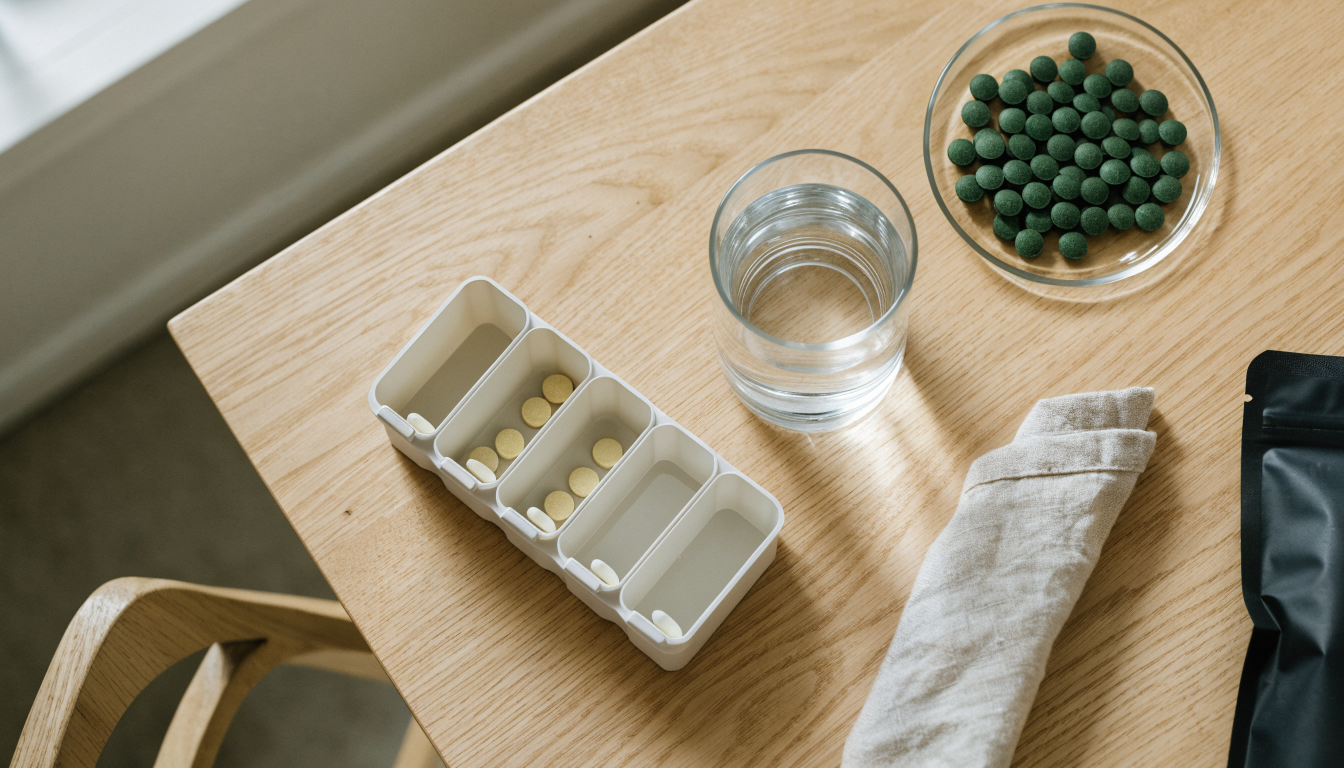
Most spirulina and medication questions are about timing, not danger.
If you take a daily prescription and are considering algae, the honest answer is more reassuring than the internet makes it sound, and more nuanced than a flat yes or no. Spirulina is a food. People have eaten it for centuries, and it does not behave like a drug. The published record of confirmed interactions is thin.
Still, a few medication categories have a real mechanism worth thinking about, and some health conditions make spirulina a poor fit regardless. This article is educational, not medical advice, and nothing here should be used to stop, start, or adjust a prescription.
Not many, and that is worth saying plainly. Unlike St. John's wort or grapefruit juice, spirulina has not been shown to meaningfully alter the liver enzymes that clear most prescriptions. The cautions you will read, including the ones below, are extrapolated from what spirulina contains rather than from documented cases of harm.
That is not a reason to shrug it off. It is a reason to be honest about the gap between a theoretical concern and a proven one. For the wider picture, our overview of spirulina side effects is the companion piece to this one.
This category deserves the most attention. Spirulina contains vitamin K, the exact nutrient warfarin dosing is calibrated against, so a sudden change in intake can shift your numbers. The guidance most anticoagulation clinics give for vitamin K containing foods is not avoidance but consistency: pick an amount and keep it steady.
Separately, some laboratory research suggests compounds in spirulina may influence platelet aggregation, the process by which blood cells clump to form a clot. If you already take an antiplatelet drug such as clopidogrel, or a daily aspirin, that raises the theoretical possibility of an additive effect. It has not caused bleeding problems in practice, but is worth raising before your next refill.
Spirulina is associated with immune modulating activity in research, usually framed as a benefit. If you take a drug whose entire purpose is to quiet your immune system, a supplement that may nudge it the other way is a legitimate question, not paranoia. That applies to transplant medications, some biologics, and certain autoimmune therapies.
The same logic extends to the condition itself. If you live with lupus, rheumatoid arthritis, multiple sclerosis, or another autoimmune diagnosis, ask your specialist before starting algae, even if you take no medication. The evidence is not strong either way, and your specialist knows your case.
Possibly, in the sense that both effects may point the same direction as your medication. Several small studies suggest spirulina may support healthier blood sugar and lipid markers. If you take metformin, a sulfonylurea, or insulin, that is not a problem in itself, but it is a reason to check your numbers more often at first.
Blood pressure follows the same pattern. The research is modest and mixed, though the general direction is downward. Layered on top of an antihypertensive, the sensible response is to keep taking your medication exactly as prescribed and monitor at home, so any change is something you and your doctor observe together.
Two worries get tangled here. The first is iodine. Spirulina is not a significant iodine source, unlike kelp and other true seaweeds, so the concern people carry over from marine algae mostly does not apply. We unpack that in our guide on whether spirulina is good for the thyroid.
The second worry is real but easy to solve. Levothyroxine absorbs poorly when anything else is in your stomach, which is why it is taken with a four hour gap before iron, calcium, and most supplements. Treat algae the same way. That is a timing rule, not an interaction.
| Medication category | The concern | Practical step |
|---|---|---|
| Warfarin and other anticoagulants | Vitamin K can shift clotting numbers if intake swings | Tell your clinic and keep your daily amount consistent |
| Antiplatelet drugs and daily aspirin | Possible additive effect on platelet clumping, mostly theoretical | Ask your prescriber first, and mention any easy bruising |
| Immunosuppressants and biologics | Spirulina may modulate immune activity in the opposite direction | Get specialist clearance first, especially after a transplant |
| Diabetes medication | Blood sugar may shift, so a stable dose could behave differently | Monitor closely for the first month and report changes |
| Blood pressure drugs and levothyroxine | Additive lowering effect, or reduced absorption in the thyroid case | Monitor at home, and leave four hours around levothyroxine |
Four habits cover almost every situation. First, separate algae from medication by roughly two hours as a general rule, and four hours around levothyroxine. Second, start low. A tablet or two for the first week tells you more than a full serving, because a smaller change is easier to interpret if something feels off.
Third, tell your doctor and your pharmacist. A pharmacist is the cheapest and fastest expert you have, can check your full list in minutes, and needs no appointment. Fourth, change one thing at a time. If you are also adding magnesium or a multivitamin, stagger them, as we explain in our piece about taking spirulina with other supplements.
ENERGYbits Spirulina is a single ingredient tablet with no fillers or additives, which makes it simpler to review with your pharmacist than a multi ingredient blend.
Shop ENERGYbits SpirulinaThere is one firm contraindication. People with phenylketonuria, an inherited condition affecting how the body handles the amino acid phenylalanine, should avoid spirulina, because it is a concentrated protein and therefore high in phenylalanine. That one is a clear no.
Beyond that, get individual clearance if you are pregnant or nursing, have gout or kidney disease, or are managing an autoimmune condition. Sourcing matters too, and so does amount, which we cover in our article on how much spirulina is too much. If you take chlorella too, the considerations differ slightly, as our guide to chlorella and medication interactions explains.
Join our newsletter for plain-language guides on spirulina, chlorella, and everyday wellness.
SubscribeDocumented interactions are limited and mostly theoretical, but a few categories deserve a conversation with your prescriber: blood thinners and antiplatelet drugs, immunosuppressants and biologics, diabetes medication, and blood pressure medication. Thyroid medication is a timing question, not an interaction. Tell your doctor and pharmacist, and never adjust a prescription yourself.
Ask your prescriber first. Spirulina contains vitamin K, the nutrient warfarin dosing is calibrated against, and some laboratory work suggests it may affect platelet clumping. The usual advice is not avoidance but consistency, so your monitoring stays meaningful. Do not start or stop without telling the person who manages your dosing.
Two hours is the general habit most pharmacists suggest for any food based supplement taken alongside medication, and four hours is the standard spacing for levothyroxine. This is about absorption rather than danger. If your pharmacist gives you a different window for your drug, follow their instruction instead.
Yes. People with phenylketonuria should avoid spirulina because it is high in phenylalanine. Anyone with an autoimmune condition, anyone taking immunosuppressant drugs after a transplant, and anyone pregnant or nursing should get individual clearance first. People with gout or kidney disease may also want to check, since algae is purine rich.


